Ragdoll MMA has separate spaces for learning controls, testing against bots, fighting other players, competing in Ranked, focusing on wrestling, and teaming up in 2v2. The most useful choice depends on what you want to practice: use Practice for repeatable input tests, move through the three bot labels for increasing pressure, and reserve Ranked for matches where competitive progress matters. Wrestling and 2v2 are not just cosmetic variations; they change which decisions matter during a fight.
Ragdoll MMA modes at a glance
The table below treats a mode as a player-facing way to enter a different practice or match situation. It does not assign hidden AI values, ranking points, queue rules, or rewards that are not documented. If a mode’s current selection screen uses different wording, follow that live label.
| Mode | Format | Main use | Entry or important limit |
|---|---|---|---|
| Practice | Solo training | Test movement, strikes, grapples, takedowns, releases, and ground control | Open it from the Learn tab; it is not a scored match |
| Easy Bot | Bot match | Build combat timing with lower-pressure opposition | Select a bot match; exact AI settings are not published |
| Medium Bot | Bot match | Practice a complete round with more time and defense pressure | Select the Medium bot label; exact AI settings are not published |
| Hard Bot | Bot match | Increase the pressure before fighting a player | Hard is bot difficulty, not a player rank |
| Player Challenge | Player match | Fight another player outside the clearest Ranked progression | Choose the challenge option and wait for an opponent |
| Casual | Non-ranked player match | Play a live match without making Ranked progress the central purpose | Use the Casual queue; exact matchmaking rules are not documented |
| Ranked | Competitive player match | Play with competitive progress and rank context | The available record shows Bronze; exact scoring and promotion rules are not complete |
| Wrestling | Grappling-focused match | Prioritize grabs, takedowns, control, and ground attacks | Do not approach it as ordinary stand-up boxing |
| 2v2 | Team player match | Coordinate two fighters against another team | Target switching and team positioning matter; queue rules are not documented |
These entries divide into three practical groups. Practice and the bot labels are preparation tools. Player Challenge, Casual, and Ranked are player-versus-player choices with different competitive intent. Wrestling and 2v2 describe specialized match formats: one emphasizes grappling exchanges, while the other adds a teammate and a second opponent to every decision.
Practice and bot difficulties
Start in Practice when an input is unfamiliar. The training area is accessed through the Learn tab and is intended for trying movement, punches, kicks, blocking, grabbing, diving, releasing a one-handed hold, and ground-control actions. That makes it different from a bot match: Practice lets you isolate an action without treating the session as a complete round, while a bot gives you an opponent who can interrupt the sequence.
The Ragdoll MMA controls reference lists the reported inputs to test and flags the bindings that still need verification.
A useful progression is:
- Practice the input. Check that your movement, strike, grab, and release actions produce the expected result.
- Try Easy Bot. Use the lower-pressure opponent to connect actions while reacting to a moving target.
- Move to Medium Bot. Test whether you can keep a plan when the exchange lasts longer or the opponent creates more defensive pressure.
- Use Hard Bot as a stress test. Treat it as a demanding rehearsal before a player match, not as proof that you have earned a rank.
The labels Easy, Medium, and Hard identify bot difficulty. The available information does not provide fixed health, damage, reaction, attack frequency, or movement multipliers for those bots. Do not infer a numerical difference from the label alone, and do not assume Hard is related to Bronze or another player rank.
Bot matches also do not replace Practice. If a grab keeps failing, return to the training area and isolate the grab and release rather than repeatedly blaming the bot. If the input works in training but breaks under pressure, the bot has already supplied useful feedback: the next goal is timing, spacing, or recovery, not a new control.
Player Challenge, Casual, and Ranked
The player-facing modes separate live competition by purpose. Player Challenge is the direct choice when you want to fight another person. Casual is the non-ranked option described in the available match record. Ranked is the competitive option tied to rank context; one record places the player at Bronze while entering the Ranked lobby.
Use this decision rule:
- Choose Player Challenge when the immediate goal is a live opponent and the challenge option is available. It is a useful bridge from bots to human timing because the opponent can punish predictable attacks in ways a bot may not.
- Choose Casual when you want a regular player match without making rank progress the focus. It is the safer place to test whether your Practice or bot habits survive a human exchange.
- Choose Ranked when you are ready to treat the match as competitive progress. Read the current rank and queue information in the game before committing, because the exact point changes, promotion thresholds, matching rules, and exit penalties are not established here. The rank progression reference separates the visible tiers from rules that remain unconfirmed.
The core combat systems remain relevant across ordinary matches. Strikes and stamina affect whether you can keep attacking, while grappling and knockouts affect how an exchange ends. A standard match description supports three one-minute rounds and an ending by knockout or scored decision, but that does not prove every specialized mode uses identical round length or judging. Check the in-game HUD for the active mode’s round and score display.
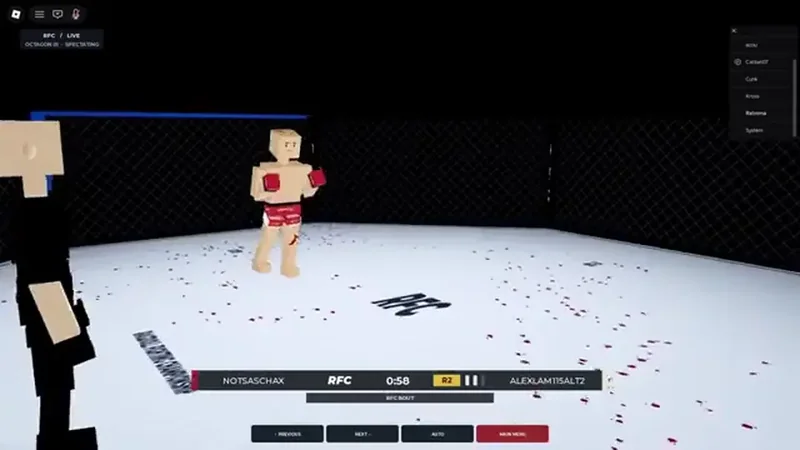
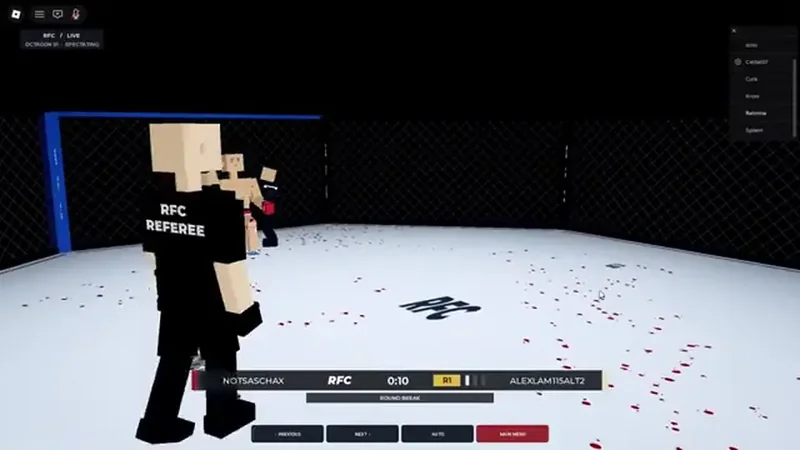
A visible knockout is also not the same as a complete explanation of the result. Physics reactions can make a fighter collapse or fold, but the player should use the match result, round card, or HUD to confirm whether the game recorded a knockout. In Ranked, do not assume a dramatic animation by itself tells you how rank progress changed.
Wrestling changes the win condition
Wrestling is a grappling-focused mode. The available match record begins it around grabbing and later describes actions involving takedowns, control, single-hand releases, ground strikes, and submissions. The practical consequence is that approach distance, grip timing, body position, and control after the takedown matter more than a simple stand-up strike exchange.
The grappling guide covers the close-range setup and follow-up decisions that matter in this mode.
See Ragdoll MMA Wrestling mode begin with a grab
The linked moment starts a Wrestling match focused on grabbing, supporting this section's emphasis on close-range control before the next ground action.

A good Wrestling plan is to think in phases:
- Close safely. Avoid treating the opening as a race to throw the biggest kick. You need a position from which a grab can connect.
- Secure the exchange. Once the grab succeeds, pay attention to whether you can maintain control or need to release one hand to change the action.
- Choose the ground outcome. A takedown can lead to ground control, ground strikes, or a submission attempt. The correct choice depends on the state shown by the game, not on a universal fixed combo.
- Recover when control fails. If the opponent escapes, reset your stance and spacing instead of continuing an unavailable ground action.
Wrestling should not be used as evidence that ordinary Casual or Ranked matches have the same emphasis. The mode exists as a specialized grappling context, so a player who succeeds there may still need separate practice for stand-up exchanges, and a striker from Casual may need to learn an entirely different sequence before relying on Wrestling.
How 2v2 works as a team choice
2v2 adds coordination to the combat systems already present in a one-on-one fight. The available team match record shows a player and teammate switching targets, attacking the same opponent, and combining kicks during a group exchange. That supports a simple team principle: communicate which opponent is being pressured rather than letting both teammates attack different targets by accident.
Watch Ragdoll MMA 2v2 target coordination
The linked moment starts a 2v2 match and supports this section's guidance to coordinate target switches and combined attacks with a teammate.

In practical terms, 2v2 asks you to track four positions instead of two:
- your own distance, stamina, and recovery state;
- your teammate’s target and location;
- the opponent you are currently pressuring;
- the second opponent who may interrupt, flank, or punish a committed attack.
Focus fire can create a fast advantage, but it can also turn into a bad pile-up if both teammates lose sight of the unmarked opponent. Switch targets deliberately when the first opponent escapes, becomes unavailable, or draws the other enemy out of position. Keep enough awareness to avoid chasing one target into a situation where your teammate is isolated.
The evidence does not establish team queue restrictions, friendly-fire rules, respawn behavior, or a separate 2v2 scoring system. Treat those as live-game questions and read the match HUD before assuming the standard one-on-one rules apply unchanged.
Choosing a mode for your next match
Use the shortest path that matches your goal:
- Learning controls:
Learn→Practice. - Testing a new strike or grab against resistance:
Easy Bot. - Testing a full sequence under more pressure:
Medium Bot, thenHard Bot. - Trying human opponents without making rank the main decision:
Player ChallengeorCasual. - Pursuing competitive progress:
Ranked, after checking the current rank display and queue information. - Practicing takedowns and ground control:
Wrestling. - Practicing communication and target selection:
2v2.
A mode change should answer a specific problem. If you cannot perform an input at all, change to Practice. If you can perform it in isolation but lose it against resistance, choose a bot. If you can execute it against a bot but cannot manage spacing or reactions against a person, choose Casual or Player Challenge. If the problem is grappling control, use Wrestling; if it is awareness under multiple threats, use 2v2.
Mode limits and current information
The named modes and their broad purposes are clear, but several details remain mutable or undocumented. Current records do not establish exact bot AI parameters, complete Ranked point rules, promotion or demotion thresholds, queue requirements, exit penalties, or whether every mode uses the same three one-minute rounds. Personal Gym also appears in training-related material, but it is not confirmed here as a separate public entry in the Modes list.
For that reason, use the current menu and HUD as the authority for availability, queue status, round timing, rank changes, and match results. The catalog is most reliable for choosing a mode by purpose: train in Practice, add pressure with bots, fight casually or through a challenge, use Ranked for competitive progress, specialize in Wrestling, and coordinate in 2v2.
First-time Ragdoll MMA mode questions
Is Personal Gym a confirmed Ragdoll MMA mode?
Not from the current mode record. Personal Gym appears in training-related material, but it is not confirmed as a separate public entry in the Modes list, so check your own menu before planning around it.
Do all Ragdoll MMA modes use the same round rules?
That is not confirmed. Three one-minute rounds are supported for the standard match description, but specialized modes may differ; use the active mode’s HUD for its round timer and result rules.
SourcesReviewed November 4, 2026
https://ragdollmmawiki.wiki/wiki/bots/